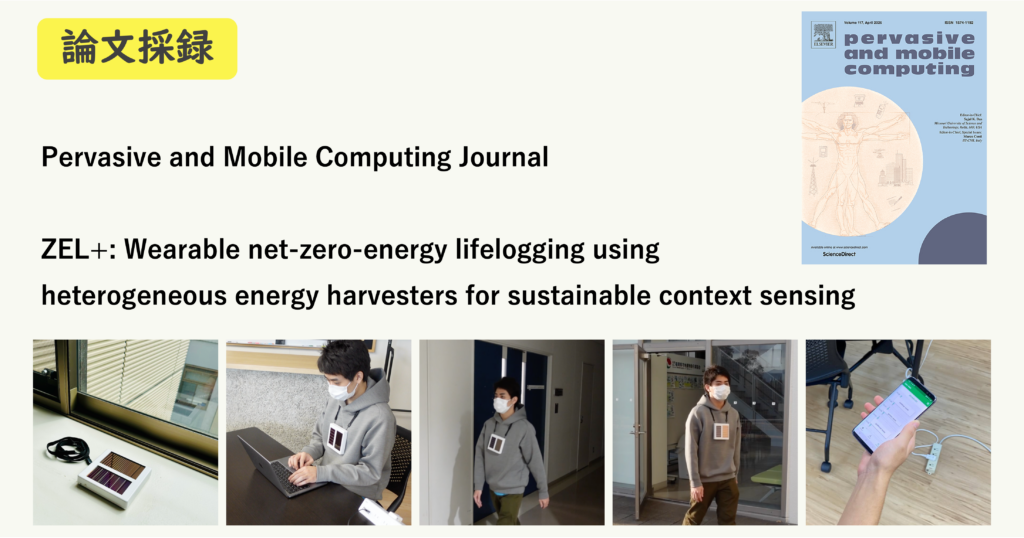
Elsevier誌のPervasive and Mobile Computing Jornalに下記の論文が採択されました。
本論文では、環境中のエネルギーのみで駆動するネット・ゼロ・エネルギー・ライフログシステム「ZEL+」を提案・開発しました。ウェアラブルデバイスにおける充電負担やバッテリー切れの課題を解消し、持続的なライフログ取得を可能にする新しいIoTセンシング基盤を実現しています。
本研究の特徴は以下の3点です。
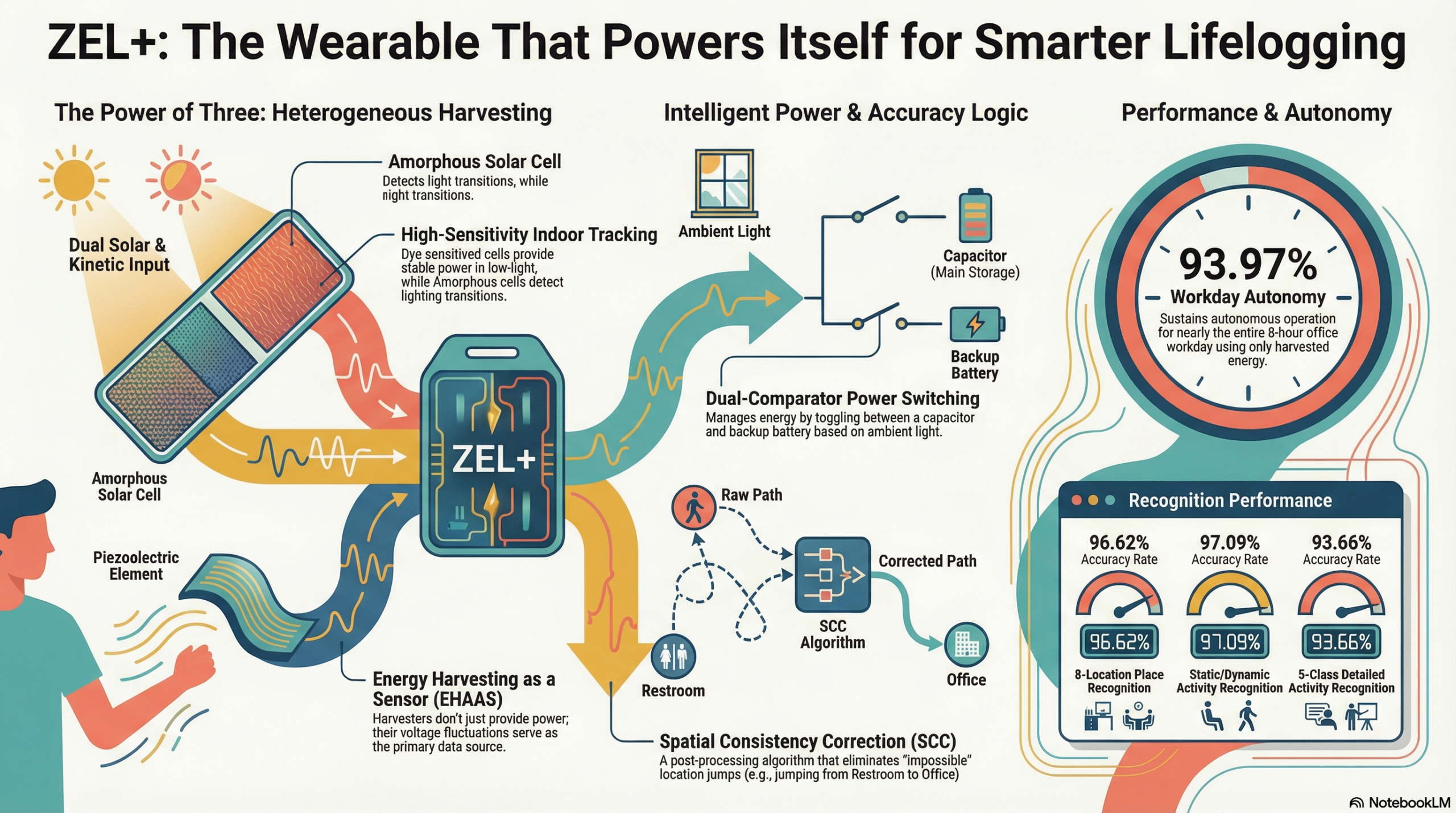
- 環境発電素子のハイブリッド活用(電源兼センサ)
色素増感太陽電池、アモルファスシリコン太陽電池、圧電素子の3種を組み合わせ、発電と同時に環境・動作センシングを実現。照度変化やユーザ動作を高精度に捉えます。 - 実環境で動作する電力管理機構
デュアルコンパレータを用いた電力スイッチング機構により、暗所を含むオフィス環境でも勤務時間の約94%を環境発電エネルギーのみで自律駆動することに成功しました。 - 空間整合性に基づく補正(SCC)アルゴリズム
建物構造上あり得ない移動を補正することで、機械学習による推論結果の一時的な誤りを除去し、矛盾のないライフログ生成を実現しました。
本システムは名札型デバイスとして実装され、11名の参加者による実証実験を実施しました。その結果、8箇所の場所認識において96.62%、静的・動的活動認識において97.09%という高精度を達成しました。さらにエネルギー持続性の観点では、標準的な8時間のオフィス勤務環境において、約93.97%の時間を環境発電エネルギーのみで自律動作可能であることを実証しました。これは、実環境下においてもほぼ終日にわたり外部充電に依存しない運用が可能であることを示しています。
本研究は、充電の煩わしさから解放された持続可能なライフログ取得を実現し、次世代IoTセンシング基盤の確立に大きく貢献するものです。
Mitsuru Arita, Yugo Nakamura, Shigemi Ishida, Yutaka Arakawa
ZEL+: Wearable net-zero-energy lifelogging using heterogeneous energy harvesters for sustainable context sensing Journal Article
In: Pervasive and Mobile Computing, 2026.
@article{arita2026zel+,

title = {ZEL+: Wearable net-zero-energy lifelogging using heterogeneous energy harvesters for sustainable context sensing},

author = {Mitsuru Arita, Yugo Nakamura, Shigemi Ishida, Yutaka Arakawa},

url = {https://doi.org/10.1016/j.pmcj.2026.102180},

year  = {2026},

date = {2026-04-01},

urldate = {2026-04-01},

journal = {Pervasive and Mobile Computing},

abstract = {This paper presents ZEL+, a wearable lifelogging system designed to operate with net-zero energy consumption by leveraging multiple energy harvesting technologies for continuous context sensing. Self-powered wearable devices often encounter difficulties in environments with inconsistent or low-intensity ambient energy, particularly in indoor settings. To address this challenge, ZEL+ incorporates three key design features. First, it employs a power-switching mechanism based on dual comparators and a capacitor to manage surplus energy and support operation under varying lighting conditions. Second, the system integrates heterogeneous energy harvesters not only as power sources but also as sensing elements. Specifically, a dye-sensitized solar cell provides stable responses under low-light indoor environments, while an amorphous solar cell exhibits sensitivity to changes in ambient illumination; together with a piezoelectric element capturing motion-induced signals, these components contribute complementary cues for location and activity recognition. Third, a Spatial Consistency-Based Correction (SCC) algorithm is applied as a post-processing step to mitigate transient recognition errors and improve the coherence of inferred lifelogs. The system is implemented as a 192 g nametag-shaped wearable device and evaluated in a real-world office environment with 11 participants. Under a person-dependent setting, ZEL+ achieved an accuracy of 96.62% for 8-location place recognition and 97.09% for static/dynamic activity recognition, while maintaining robust performance on more fine-grained tasks. In terms of energy sustainability, the device sustained autonomous operation using harvested energy alone for approximately 93.97% of a standard 8-hour office workday. These results indicate that ZEL+ provides a practical and energy-sustainable solution for continuous lifelogging in indoor mobile computing environments.},

keywords = {},

pubstate = {published},

tppubtype = {article}

}
This paper presents ZEL+, a wearable lifelogging system designed to operate with net-zero energy consumption by leveraging multiple energy harvesting technologies for continuous context sensing. Self-powered wearable devices often encounter difficulties in environments with inconsistent or low-intensity ambient energy, particularly in indoor settings. To address this challenge, ZEL+ incorporates three key design features. First, it employs a power-switching mechanism based on dual comparators and a capacitor to manage surplus energy and support operation under varying lighting conditions. Second, the system integrates heterogeneous energy harvesters not only as power sources but also as sensing elements. Specifically, a dye-sensitized solar cell provides stable responses under low-light indoor environments, while an amorphous solar cell exhibits sensitivity to changes in ambient illumination; together with a piezoelectric element capturing motion-induced signals, these components contribute complementary cues for location and activity recognition. Third, a Spatial Consistency-Based Correction (SCC) algorithm is applied as a post-processing step to mitigate transient recognition errors and improve the coherence of inferred lifelogs. The system is implemented as a 192 g nametag-shaped wearable device and evaluated in a real-world office environment with 11 participants. Under a person-dependent setting, ZEL+ achieved an accuracy of 96.62% for 8-location place recognition and 97.09% for static/dynamic activity recognition, while maintaining robust performance on more fine-grained tasks. In terms of energy sustainability, the device sustained autonomous operation using harvested energy alone for approximately 93.97% of a standard 8-hour office workday. These results indicate that ZEL+ provides a practical and energy-sustainable solution for continuous lifelogging in indoor mobile computing environments.
関連