IEEE ACCESSに1件採択

IEEE ACCESSに下記の論文が採択されました。
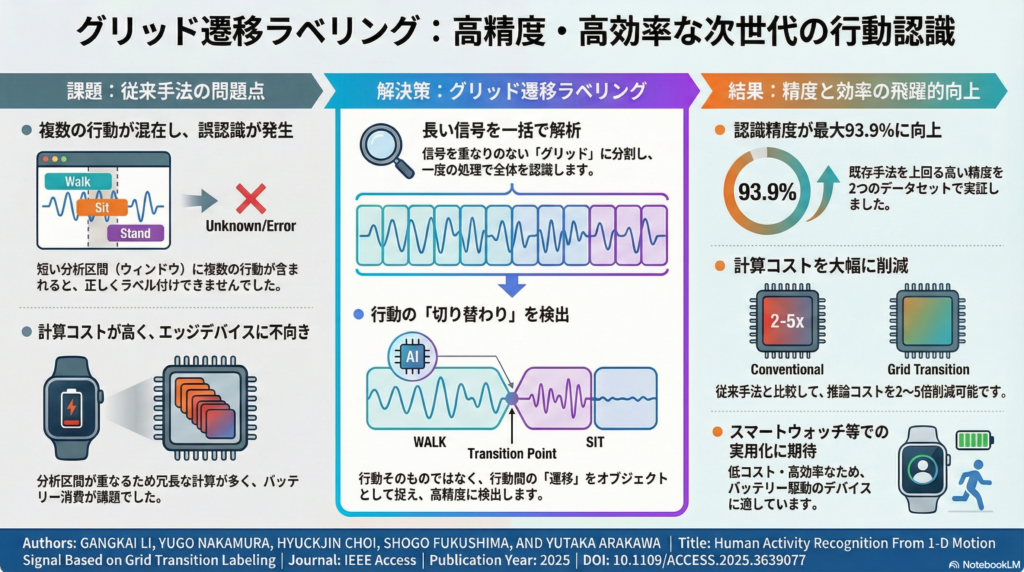
この論文は、1次元センサー信号を用いた人間活動認識(HAR)における従来のスライディングウィンドウ手法の課題を解決するために、新しいアプローチを提案しています。従来手法では、固定サイズのフレームに分割して分類を行いますが、複数の活動が混在するウィンドウや最適なウィンドウ長の決定、計算コストの増大といった問題がありました。
そこで本研究では、スライディングウィンドウを使わない「グリッド遷移ラベリング」という手法を導入しました。この手法は、2次元画像の物体検出から着想を得ており、活動間の遷移を「オブジェクト」として扱います。信号セグメントを複数のグリッドに分割し、各グリッドに遷移の有無や周囲の活動クラスをラベル付けすることで、すべてのサンプル点を効率的に認識できます。
UCI HAPTとWISDMの2つのデータセットで評価した結果、精度はそれぞれ0.930と0.939を達成し、既存のスライディングウィンドウ非依存手法(FCNやU-Net)を上回りました。また、推論時の計算コストも大幅に削減でき、スマートウォッチやスマートフォンなどのエッジデバイスでの利用に適しています。
Gangkai Li; Yugo Nakamura; Hyuckjin Choi; Shogo Fukushima; Yutaka Arakawa Human Activity Recognition From 1-D Motion Signal Based on Grid Transition Labeling Journal Article In: IEEE ACCESS, vol. 13, pp. 203723 - 203735, 2025.@article{nokey,
title = {Human Activity Recognition From 1-D Motion Signal Based on Grid Transition Labeling},
author = {Gangkai Li; Yugo Nakamura; Hyuckjin Choi; Shogo Fukushima; Yutaka Arakawa},
url = {https://ieeexplore.ieee.org/document/11271654},
doi = {10.1109/ACCESS.2025.3639077},
year = {2025},
date = {2025-12-01},
journal = {IEEE ACCESS},
volume = {13},
pages = {203723 - 203735},
abstract = {Human activity recognition (HAR) using 1-D sensor signals is a widely studied domain and plays an important role in intelligent systems. Traditional research applied a sliding window to extract fixed-size frames from the original signals and ran a classification process on them to recognize activities. However, sliding-window-based methods suffer from several problems, such as the multi-class windows problem, where all sample points share the same label in a frame even if there is more than one activity in it. The sliding window also makes it challenging to decide the best window length for all activities and causes the computational cost problem due to the redundant calculation of two consecutive frames. To solve the problems of sliding windows, in this paper, we design a novel sliding-window-free method that can recognize all activities from signal segments in a highly efficient way. As a solution, we propose grid transition labeling, which is derived from the object detection tasks in 2-D images, and we introduce new designs to deal with 1-D signal-based HAR tasks. Grid transition labeling regards the transition between two activities as an object. To detect transitions, grid transition labeling divides a segment into several grids and labels whether there is a transition in each grid, as well as the classes around transitions, therefore all sample points of the segment can be well labeled without the need of labeling each of them. To evaluate our method, we conducted experiments on two datasets, including UCI HAPT and WISDM. The results on the two datasets show accuracies of 0.930 and 0.939 respectively, outperforming two sliding-window-free methods, FCN and U-Net. Our method also has a high computational efficiency that requires much less computational cost for inference compared to both the sliding-window-based methods and the sliding-window-free methods, making it more suitable for applications on edge devices such as smartwatches and smartphones.},
keywords = {},
pubstate = {published},
tppubtype = {article}
}